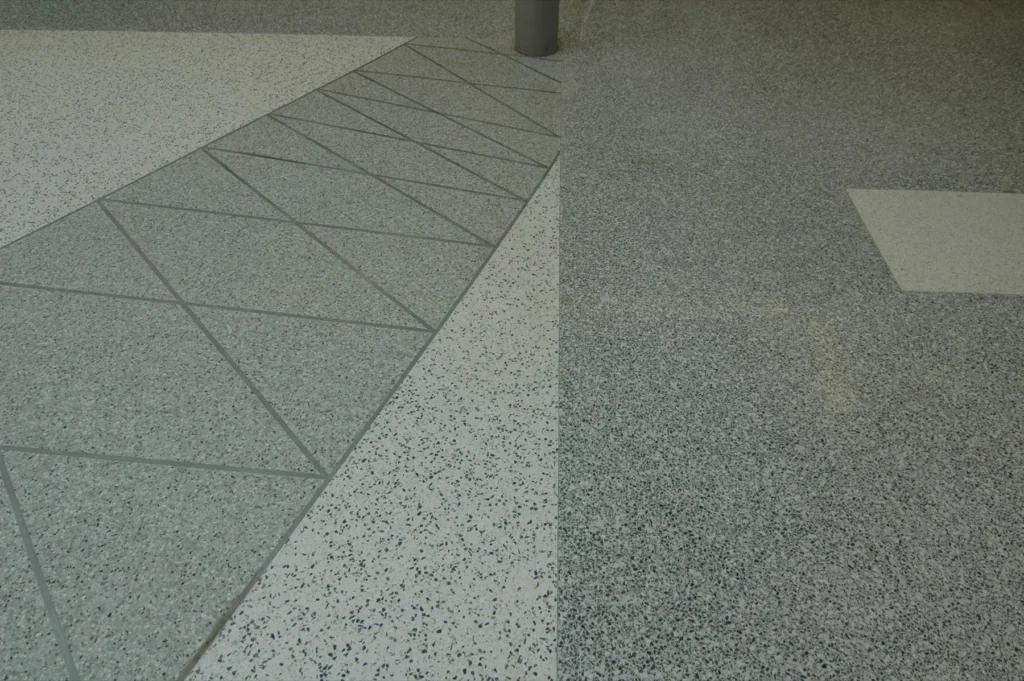
A crack running across a terrazzo lobby or corridor is one of the most common calls a facility manager makes to a terrazzo contractor. The good news is that most cracked terrazzo does not need to be replaced. The catch is that a crack patched without understanding its cause will usually come back.
Terrazzo is a finish system bonded to a concrete slab. When the slab moves, the terrazzo follows. That is why effective terrazzo floor repair in Texas starts below the surface, with the slab, the joints, and the building conditions that caused the problem in the first place.
Why Terrazzo Floors Crack
The terrazzo industry has a simple rule: as the concrete goes, so goes the terrazzo. Even epoxy terrazzo, which is more flexible than cement-based systems, cannot hold a floor together if the structure underneath is moving.
Slab movement and Texas soils
Much of Texas sits on expansive clay soils that swell when wet and shrink during dry spells. Slab-on-grade buildings such as schools, retail centers, and single-story civic buildings can see seasonal movement that shows up as cracks in the finished floor. Settlement, heaving, and thermal movement through large glass lobbies add to the stress.
Reflective cracks from slab joints
The most common cause is a slab control joint or existing crack that was covered without being honored in the terrazzo. When the slab cracks along that joint, the crack reflects straight up through the finish. Cracks that line up with columns or saw-cut joints are a strong sign of this.
Installation and moisture issues
Cracks can also come from poorly bonded divider strips, improperly mixed resin, skipped crack-isolation membranes, or high moisture in the slab. Shrinkage is a factor in cement-based terrazzo when panels are too large.
Diagnose Before You Repair
A proper assessment answers one question first: is the crack still moving? A specialist will look at the crack pattern, where it sits relative to slab joints and columns, the age of the floor, and whether the slab is on grade or on a structural deck.
- Hairline, stable cracks often stay the same width over time and can usually be filled and polished.
- Reflective cracks follow slab joints and tend to reopen unless the joint is addressed.
- Active cracks widen, shift, or reopen after filling. These point to ongoing movement that needs a joint or membrane solution, not just filler.
In healthcare facilities, airports, and schools, a widening crack can also become a trip hazard or a sanitation concern, so documenting changes over a few weeks is worth the effort.
Commercial Terrazzo Repair Options
The right repair depends on what the diagnosis shows. Most projects use one or a combination of these approaches.
Clean and fill stable cracks
If the crack is not moving, it can be cleaned out and filled with a color-matched epoxy grout, then ground and polished flush with the surrounding floor. Done well, the repair blends into the field.
Add a joint where the slab wants to move
For reflective or active cracks, the lasting fix is often to cut a new joint along the crack line and install a divider strip, sometimes paired with a flexible membrane. A clean metal strip reads as part of the design. A crack does not.
Remove and replace a section
Severe cracks or delaminated areas may need the terrazzo removed down to the slab, the slab repaired, a crack-isolation membrane installed, and new terrazzo poured. If an exact aggregate match is not possible, replacing a full panel between divider strips usually looks better than a near match patched into the middle of a field.
Restore the whole floor
After repairs, grinding, grouting, and terrazzo polishing bring the floor back to a uniform finish. In many lobbies, corridors, and civic spaces, full terrazzo restoration costs far less than replacement and keeps an original design in service for decades.
Preventing Cracks in New Terrazzo Installations
For architects and general contractors, the best repair is the one that never has to happen. Crack prevention is decided during design and sequencing, long before the first pour.
- Align divider strips with slab joints. Lay out the terrazzo pattern so strips fall on control joints and construction joints wherever possible.
- Specify a crack-isolation membrane. Treating existing cracks and joints and installing a membrane over the slab is standard practice for poured-in-place systems.
- Detail movement joints. On structural decks and in areas with expected movement, use double strips with a flexible joint rather than a single rigid strip.
- Confirm substrate and moisture conditions. Slab flatness, cure, and moisture levels should be verified before installation, not assumed.
- Coordinate early. Bringing the terrazzo contractor in during design development helps resolve joint layout, finish expectations, and sequencing with other trades.
An experienced commercial terrazzo contractor will flag these details during submittals, which protects both the schedule and the long-term look of the floor.
Work With a Terrazzo Specialist
Andreola Terrazzo & Restoration has worked in terrazzo since 1978, serving commercial and institutional projects across Texas, Oklahoma, Arkansas, Northern Louisiana, New Mexico, and Nevada. Our team handles crack assessment, terrazzo repair, polishing, and full restoration, along with new terrazzo flooring installation and precast terrazzo from our in-house plant. If your facility has cracked or worn terrazzo, or you are planning a new floor and want the joint layout right from the start, contact Andreola for a project consultation.
Andreola Terrazzo & Restoration
Cracks in terrazzo are rarely random. They usually trace back to slab movement, unhonored joints, or installation conditions, and in Texas, soil movement is often part of the story. The right repair matches the cause, whether that is a simple fill and polish, a new divider strip, or a section replacement. Reach out to Andreola Terrazzo & Restoration to plan a terrazzo floor repair, restoration, or new installation that holds up for the long term.