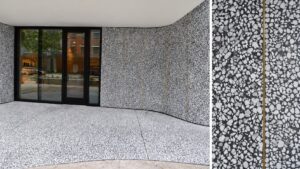
Most conversations about terrazzo start and end with the floor. But the same qualities that make terrazzo a long-term flooring choice (density, color control, and a surface that can be refinished rather than replaced) also apply to vertical surfaces. For architects and owners looking for a wall finish that can handle impact, cleaning, and decades of public use, terrazzo wall panels deserve a closer look.
Why Consider Terrazzo on Walls?
Interior walls in public buildings take constant abuse from carts, luggage, backpacks, wheelchairs, and cleaning equipment. Painted drywall scuffs, vinyl wall coverings tear, and many decorative panels show wear within a few years.
Terrazzo wall panels address that problem with a dense, nonporous surface that resists impact and holds up to routine cleaning. Because the aggregate runs through the full thickness of the panel, color and pattern do not wear off. When a panel eventually dulls or picks up a chip, it can typically be repaired and polished in place.
There is also a design advantage. Wall panels can be matched to the floor terrazzo, which lets designers carry a color palette, pattern, or custom terrazzo logo from the floor up the wall for a continuous, intentional look.
Where Terrazzo Wall Panels Work Best
Wall panels are a strong fit anywhere that durability and appearance matter equally:
- Office and hotel lobbies, as feature walls, reception backdrops, or elevator surrounds
- Airports and transit facilities, along concourses and high-traffic corridors
- Schools and universities, in entries, corridors, and donor recognition walls
- Healthcare facilities, where cleanable, durable surfaces support daily operations
- Civic and government buildings, in rotundas, courthouses, and public halls
- Restaurants and retail spaces, as accent walls, bar fronts, and service counters
Panels are also commonly used for wainscots, column wraps, and stair walls where the terrazzo on the floor and treads can continue vertically.
How Precast Terrazzo Wall Panels Are Made
Most terrazzo wall panels are produced as precast terrazzo. Panels are cast, cured, ground, and polished in a controlled plant environment, then delivered to the site ready to set.
Fabricating off site keeps curing and finishing independent of jobsite conditions, allows panels and matching floor elements to be color-matched by the same team, and lets fabrication run while other trades are still working. It also reduces on-site disruption, which matters in occupied hospitals and schools.
Panel size, thickness, and edge profiles are determined by the design intent, weight limits, handling requirements, and the wall assembly behind them.
Coordination Points for Architects and Contractors
Substrate and Attachment
A terrazzo panel is only as reliable as what it is attached to. The wall substrate, framing, and backing need to be designed for the weight of the panels, and the attachment method (mechanical anchors, adhesive setting, or a combination) should be confirmed early with the terrazzo contractor and, when needed, the structural engineer.
Layout, Joints, and Transitions
Panel joints are part of the design. Joint locations should be laid out on elevations and coordinated with doors, outlets, signage, fire alarm devices, and other wall penetrations. Transitions to adjacent finishes and to the floor terrazzo, including any base or cove details, should be resolved in the drawings rather than in the field.
Sequencing and Protection
Panels are typically installed late, after overhead work and wet trades are complete, and should be protected from other trades until turnover.
Finish Expectations
Aggregate, matrix color, and polish level should be approved from physical samples, ideally viewed under the building’s actual lighting.
Lifecycle Value and Maintenance
Routine maintenance usually involves neutral cleaners and periodic inspection. Over time, localized damage can be addressed through terrazzo repair, and dulled surfaces can be restored through terrazzo polishing. For facilities that plan on 30 years or more of use, fewer replacement cycles can offset a higher initial cost compared with many conventional wall finishes.
Plan Your Terrazzo Wall Panel Project
Andreola Terrazzo & Restoration has worked in terrazzo since 1978 and operates an in-house precast plant, which allows wall panels, stair treads, countertops, benches, and custom inlays to be fabricated and matched to field terrazzo under one roof. As a commercial terrazzo contractor, our team works with architects, general contractors, and facility managers on layout, attachment details, sampling, and installation.
If you are considering terrazzo wall panels for a lobby, corridor, or public space, contact Andreola early in design.
Conclusion
Terrazzo wall panels extend the durability and design flexibility of terrazzo beyond the floor. With early coordination on substrate, attachment, joints, and finish, they deliver a wall surface that lasts for decades and can be repaired rather than replaced. For precast wall panels, terrazzo flooring installation, or terrazzo restoration across Texas, Oklahoma, Arkansas, Northern Louisiana, New Mexico, and Nevada, contact Andreola Terrazzo & Restoration to start planning.